
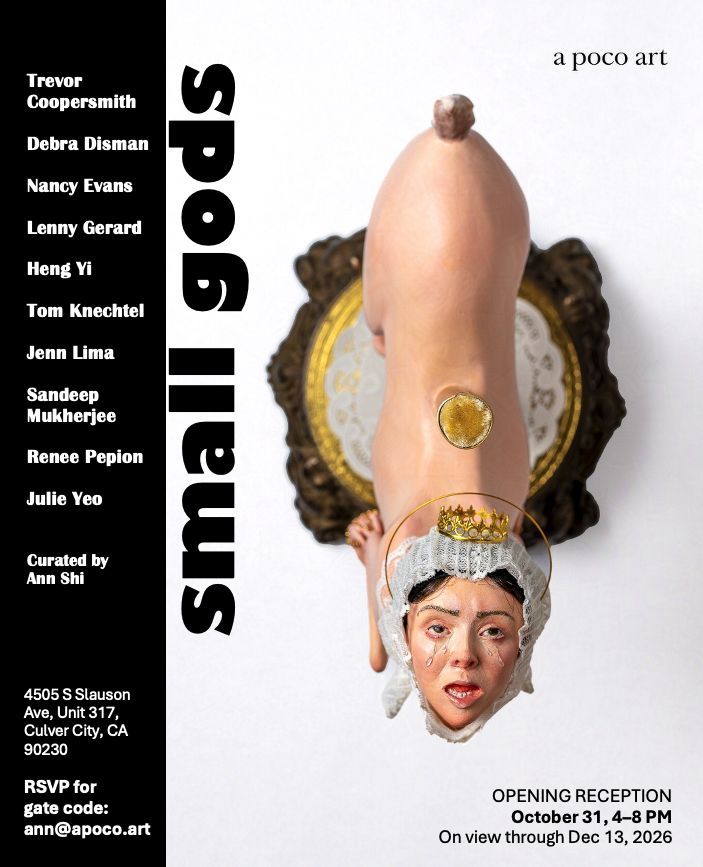
“Our gods are small not because they are lesser, but because they are near, they are everywhere. They dwell in your and me, in bodies, in animals, plants, and spirits; in the earth beneath us and the air we breathe. Neither distant nor singular, the divine takes countless forms, appearing and disappearing in the ordinary fabric of existence. To encounter a god, perhaps, is not to look toward heaven, but to look again—
… among us.”
October 31 – December 13, 2026
Opening Reception: Saturday, October 31, 4–8 PM
Curated by Ann Shi
Presented by a poco art, Los Angeles
Opening on Halloween, small gods: Desire, Devotion and the Making of Power brings together ten artists who challenge the boundaries between human and animal, divine and demonic, sacred and profane. Through hybrid bodies, unruly idols, playful monsters, and intimate shrines, the exhibition explores how desire, belief, and imagination transform ordinary beings into objects of worship or fear.
At the heart of small gods is the Buddhist concept of “相”: form, appearance, or the characteristics through which we perceive and distinguish things. In the Diamond Sutra, appearances are understood as provisional rather than permanent realities. The text introduces “一合相”, the apparent unity of composite phenomena: what seems to be a coherent whole is, in fact, a contingent gathering of interdependent parts. Even this unity, the sutra reminds us, must not be mistaken for an absolute truth.
Extending this proposition into the visual and material realm, small gods imagines the body itself as a composite being— human, animal, ghost, god, saints, and something yet unnamed. These hybrid creatures expose the instability of the boundaries themselves. An animal can become a deity, a toy, an object of worship; or a monster, an intimate self-portrait. What we call divine or demonic may reveal less about the being before us than about our own fears, desires, and systems of belief.
The exhibition questions the moral binaries through which religious and cultural traditions have shaped our understanding of good and evil, the sacred and the profane. Catholic iconography, Buddhist cosmology, Asian diasporic memory, queer fantasy, and popular mythology intersect, revealing how images of saints, demons, salvation, temptation, and enlightenment acquire cultural and spiritual authority. Yet these distinctions become unstable when holiness is mistaken for an image, goodness for an appearance, or spiritual attainment for an identity. The Buddhist concept of 著相, attachment to form and appearances, offers a particularly compelling paradox: even the pursuit of enlightenment can become another form of attachment when awakening is treated as something to possess, achieve, or embody. Our impulse to impose fixed identities and moral hierarchies becomes ironic when these forms of existences are inherently fluid, contradictory, and beyond our complete control. -Curatorial Statment